


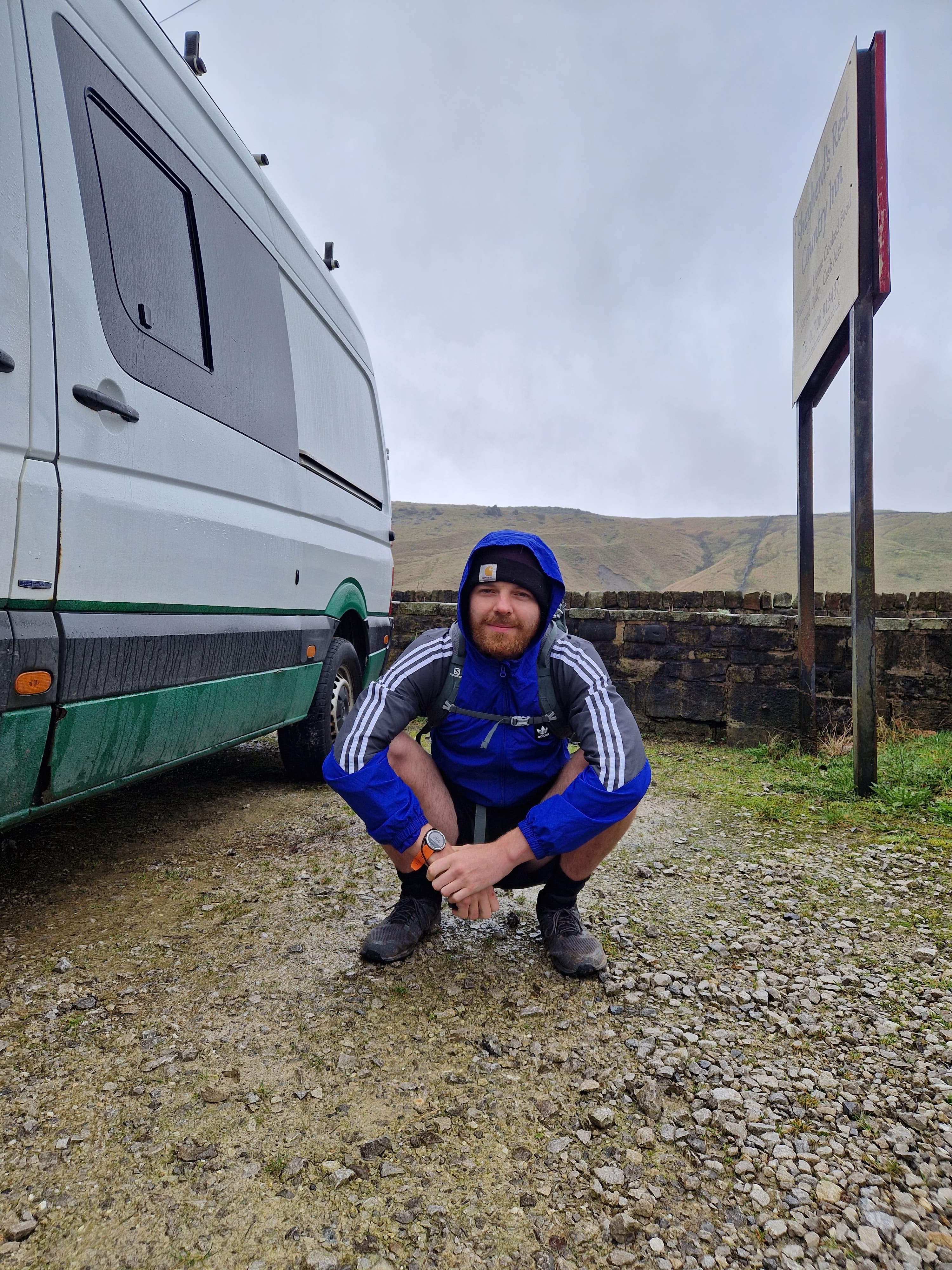
December 2022, I took a jump from my longest running distance of 27 miles, to 50k (31 miles). About a week later, when I should have been letting my body recover, I ran a ten mile fell route called Black Hill in Crowden - a Christmas eve tradition with my mate Jim. We trot up onto the boggy-ass moors, leap over and fall into knee-deep peat bogs, get battered off the wind and rain, justifying a few Baileys and what not over the next few days.
During this, something went wrong with my foot, and it started clicking. I thought it'd be best to let it recover before I got back into running. Weeks turned into months and before I knew it, it was August and I'd barely ran all year, and my foot wasn't much better. I wanted to beat my 50k distance record before the end of the year so I started training and hoped my foot would hold up.
Leading up to the 50k, I was in the habit of running 20+ miles a week and really enjoying my running. Once you're out of the habit it becomes very difficult to get back into it, so it was a bit stop-start in the beginning. Setting a habit is difficult, but once you've done it, it's just as difficult to break it. It can take a while to get into it but, once you start to enjoy it, the training becomes easier. You start embracing it for what it is. Rather than the goal being the focus, you begin to love the process.
Focusing on future goals instead of process can be detrimental for many reasons. An example of the pitfalls of goals is; when Tyson Fury achieved his goal of becoming world heavyweight champion by beating Wladimir Klitschko in 2015, his life spiralled out of control. He started smashing drugs and living recklessly, losing the will to live, and coming close to suicide. This was because his life was built around the achievement of this one external goal. His life was based around achieving something which ultimately rendered his life meaningless once he'd achieved it. This is one of the problems with extrinsic motivation. It cannot fuel us indefinitely. If his goal was to become as strong a fighter as he can possibly be, the external validation of a belt wouldn't have held as much significance because he would still have had levels of greatness to achieve.
Stoic philosopher Epictetus believed that if we pursue things that are outside of our control, it's possible that we won't get them, and then we will fail to achieve happiness and freedom. The only things which can bring us happiness are those which are entirely under our own control. Such as our motivation and desire. If Fury's motivation was intrinsic, instead of going into a downward spiral, he could've gone on a rampant run, defending his belt, and proved categorically that he's the best alive by beating Wilder, AJ, Usyk, and whoever else over the next couple of years. Instead, he's still got a few doubters out there and his legacy is debatable.
In order to have one's life filled with meaning, one needs to implement a meaningful process. That way, meaning is gleaned not from achieving goals but from simply being on the right path. It's all about aligning our values with our actions. As Epictetus said, don't talk about it, be about it. Whether or not our goal is to be world champion, or to finish in the top 10% of marathon finishers, if our goal is external, it will lead to dissatisfaction. The focus must always be on process. If it's on an outcome we can't control, we will be knocked when we fail to achieve it or lose our purpose once we do.
The process for nailing this run revolved around doing three runs a week for a few months and then I decided to streamline the mileage into two runs to free up time for other stuff. Generally doing one shorter faster run (3–10 miles), and one longer, slower run (10 to 23 miles). Halfway into the training, I beat my pace PB for eight miles, without intending on even running fast. This demonstrates the importance of consistency. If you practice what you're trying to get better at consistently, you will improve.
Expert on habits, James Clear, uses an analogy of an ice cube to illustrate this kind of thing. If the temperature is minus ten Celsius, and it's increased by one degree, it will seem that nothing is changing. If it continues to be heated, if habits continue to be repeated, eventually the ice will change state and turn into water. The water resembles the times when the fruit of our habits become apparent. Sometimes it appears that we are getting nowhere, but if we continue to trust the process, eventually it will become clear that our work is paying off.
In terms of the long training runs, I'd only ran a couple of 23 milers. So, leading up to the 40 miler, I was unsure whether my body would be able to hold up for about 7 hours of running (the longest training run was under 5 hours - Edale Skyline). Although I knew I'd finish it, injury riddled or not!
I was aiming to do it before the end of 2023 but wasn't ready at all, the longest I'd ran was about 17 miles, so it would've been guaranteed injury tackle. I rearranged it with Jim to attempt it 3rd Feb. Unfortunately, he picked up a bit of an injury and pulled out. He's always the navigation/route man, who takes us on scenic runs around the Peaks and Lakes. Without him, I decided to resign myself to running around the glorious Tameside, with a detour up to Dovestones.
I went to a party the night before and managed to only have one pint, to prioritise the run, but ended up having a broken sleep anyway, interspersed with dreams about finishing the 40-mile slog. Got up at about seven, nailed a coffee and some calorie dense baked oats with cacao powder, medjool dates, melted dark chocolate pieces, banana, and cream. Then I packed my bag with some water, tofu & avocado butties, buttery, salty, baked potatoes, fruit, and then head out.
I felt heavy and tired at the start and felt a weird pinch in my shoe which I took off hoping to remove a stone several times before giving up and dealing with the annoyance (this turned out to be an absolute monstrosity of a blister). I head out from Droylsden up to Hartshead Pike (about 700ft incline) at a slow but steady pace. I ran into Mossley, up to Dovestones, back through Mossley, then Stalybridge, and back down the canal, before going for a pitstop at around the 26-mile mark. Downed Beroccas and coffee, refilled water, grabbed more food, changed shoes and socks, and head back out for another shorter 14-mile version of the route I'd just done (cutting out the Dovestones bit).
After getting back up Hartshead Pike, about 50k in, my legs started to massively slow down and I was running downhill just as slowly as I was running up because it felt like I was teetering on the edge of shafting my knees. I dropped back down onto the canal for the eight mile, flat, home stretch, running out of gas. Time started to slow down, and every mile felt like two. By this point I just wanted it to be over, but I managed to keep from feeling too sorry for myself. After about five-six hours of monotonously plodding around with nothing to take my mind away from the misery, it was seriously dragging, as I made my way through Stalybridge and Ashton. I run without earphones these days and use it as time to clear my head and allow my brain to process information rather than filling it with constant stimulus.
But seven hours of being alone with your own thoughts and not putting on some bangers, or motivational words to distract you can be testing. However, it's important to be able to motivate yourself to do hard things on your own steam, with no external support. Plus, sometimes on longer runs it can backfire. I remember doing one of my first half marathons, Inspector Norse came on in my earphones, which made me start hammering it for five minutes. Only to end up burning energy that I didn't really have and slowing down shortly after.
Regarding relying solely on internal juices to get you through a run, this ability to keep on going when you want to stop, is transferable onto other aspects of life. You're not just building physical endurance, but also mental endurance. The body and mind are intimately connected and at the deepest level of the brain, physical and mental pain are experienced as the same. If we choose to put ourselves through suffering, in the knowledge that it will make us stronger, when life throws an unavoidable dose of suffering at us, we're better equipped to deal with it because we've spent time in this place before - by choice. In these times, a Skrillex anthem probably isn't going to get you through it. Neither will a passionate Goggins rant. It's got to come from within.
Saying that, I did receive some external motivation. As I slowly trapsed back towards Droylsden, a middle-aged man who walked past gave me a bit of endearing cheerleading; "Come on, keep going!". He must've been able to tell that I was flagging, and it triggered something in me emotionally. Sometimes these small, kind words can have a profound effect on us. It sparked a burst of energy which turned my snail pace into turtle speed. I started thinking about all the months of training I'd put in, about how I was so close to finishing one of the hardest things I'd ever done. I managed to keep the pace up after this for the last few miles, but more importantly, it gave me a massive mental boost. This was an example of how external motivators can be helpful sometimes. Although they're not as resilient and reliable as intrinsic factors, they can be useful as long as they're not our main focus.
On the topic of motivation, here are my many motivations for attempting this; firstly, I wanted to do something I'd never done before. Running 40 miles is something that a few years ago I could never have imagined myself doing. This makes me question what else I can achieve in the next few years, not just in running, but in other areas of life too. Secondly, discipline is something I value highly, and running is an ideal method of cultivating it. You're not depending on anyone, you don't need any gear, just a pair of shoes. So, you schedule your runs in, and if you can get yourself to do the plan, you'll achieve the goal, and working towards goals is a huge part of being human! There are other intrinsic factors that I relied on for motivation, but I'd be lying if I denied the role of any extrinsic factors.
Last year I deleted Strava to eliminate all extrinsic factors. I mistakenly thought that we are either intrinsically or extrinsically motivated, but we are usually motivated by a combination. If submitting a run on Strava plays a role in motivating you to get running, then that is a good thing that you should occasionally take advantage of. However, if this is the main reason for running, then unfortunately you will not be able to rely on this motivation in tough times. Same with other extrinsic factors; losing weight, running a certain pace, etc. As Nietzsche said, he who has a why to live, can bear almost any how. When you're in pain, extrinsic why's will not be able to bear the how's of visceral pain. In that moment when the pain approaches the boundaries of what you believe you're capable of enduring, if you're doing it for Strava, chances are, you'll slow down or quit and just not post that activity. Whereas if you're doing it because you want to see how far you're capable of pushing yourself, or to make your family proud, in that split second, you're more likely to hang in there.
Ross Edgley, in his book about swimming around the circumference of Britain, cites a study in which 11,320 West Point military cadets were followed over a 14-year period. Those who joined due to internal factors were more likely to graduate, receive promotions, and become commissioned officers, and stay in the military compared with those who enrolled due to external motives. This shows us how through adversity we need strong intrinsic principles to depend upon, which are proven to be much more resilient than extrinsic ones.
I finished the run strong and boxed off another bowl of baked oats, downed about a litre of fizzy ginger cordial and then festered in the bath for about two hours, celebrating with a fruit salad and a brew. Embracing one of the joys of long-distance running - the freedom to consume as many calories as possible. Another joy is having something to show off about. Although I'd like to pretend I don't care if people know about my runs etc., that'd be pure lies. We all want to be recognised for our achievements and anybody who says that they don't is full of shit.
This isn't the only reason that I'm posting a blog about it though. Other than showing off… I wanted to see if it is possible, partly to show myself how much I'm leaving on the table, and partly in hope that somebody else might listen to me rambling on about it and get inspired to challenge themselves.
If you want to learn more about intrinsic and extrinsic motivation, check out George Monbiot's writing or Ross Edgley on Rangan Chatterjee's podcast. If you're interested in learning more about habits, read James Clear - Atomic Habits.